Engaging with conflict with empathy and curiosity

Category: Faculty Alumni

Q&A: the beginning

When did you start teaching/coaching at the Centre for Conflict Resolution?

I was the first instructor.

What inspired you to become a Conflict Resolution faculty member?

My experience as the Outreach Coordinator for the JI organizing conferences through the province on many issues surrounding family violence.

How did you hear Centre for Conflict Resolution at the JIBC?

I was the first Coordinator for the Centre.

What was your job(s) before teaching at the JIBC?

Special Projects Director for the Vancouver Volunteer Centre

What is the most important thing you hope your students leave your classroom with?

Deeper understanding of themselves and others as they experience conflict in their lives.

  • Marje Burdine

The belief in resolutoin and the confidence in experiential learning

Submitted with appreciation:

It is an honour for me to have been a part of creating the Centre for Conflict Resolution. The Justice Institute was unique in providing the freedom and support for this innovative program. The elements that lead to the first mediation course were three-fold: the belief that we could offer a way for individuals and communities to resolve conflict at every level; the confidence in experiential learning as the appropriate adult education method; and the availability of divorce mediation approaches and models.

The first 3-day mediation course filled quickly with 20 registered participants, but we were amazed when twice that number showed up hoping to be allowed in. The enthusiasm was so powerful that we pushed back the desks and added many more chairs to accommodate everyone. That was the beginning of “something big”! The other courses evolved organically to eventually comprise the original Certificate Program.

One of my early memories was sitting on Paula Temrick’s living room floor with Paula, Stacey Holloway, Joan Balmer, Dale Zaizer and Mario Govorchin, trying to envision where all of this could be leading. We were already stretching the capacity of the old JI’s registration system and classroom availability. Yet we knew there was no limit to the Centre’s growth if we could find enough strong trainers and coaches. We had to set high standards and not compromise even under pressure. This lead to the immediate addition of Michael Fogel, Gordon Sloan, Arthur Ridgeway, and Dale Trimble. We identified strong participants in the courses and invited them to become coaches and potentially trainers, including Karen Haddigan, Tim Langdon, Nancy McPhee, Gary Harper, Sally Campbell, Ron Monk,Donna Soules, Angie Chalke, Deborah White, Ed Jackson and Randy Boychuk, I desperately needed administrative help, too, and magically Tad Dick appeared in my office in search of a career change. Voila! An angel disguised as a former bank manager! Those were such exciting years for all of us.

A special memory I want to share with you happened to me just last week. While grocery shopping, I was stopped by a large, gentle man in his late fifties. He recognized me and said he had hoped to have the chance to tell me something some day. When he was a high school classmate of my son, Kent Highnam, Kent showed him a video that he and I had made demonstrating conflict resolution skills. He said that brief exposure changed his whole way of thinking about conflict. He has carried this with him for about 40 years and uses it in his role as a company manager. The expression on his face warmed my heart and I’m so glad we met that day. And I’m so proud and pleased that Kent has returned to the JI and the CCR after starting there as a student so many years ago.

I’ve had many encounters with friends and acquaintances over the years who have told me how life-changing were the courses from the Centre for Conflict Resolution. Most often, they were unaware of my involvement with the JI so this meant even more to me. I’m sure many of you have had similar experiences. How rewarding it is to know that we have made a difference in so many lives!

  • Marje Burdine

The Magic of Learning and Sharing (Faculty Stories)

What a special idea to reflect back on the special memories of connecting and learning. In 1991, I became a student in the Justice Institute (JI) Conflict Resolution program at Jericho. My goal was to take the material back to a small alternate school in Nanaimo where I was a counsellor for thirty-five grade 8 – 10 students.

During my time at the JI, Marg Burdine was inspirational in guiding me on path that shaped an exciting future in ways she may never have known. The learning I received created a mind shift that was new for me. Struggling to embody the skills resulted in responses like – “Don’t do that stuff on me.” Trying to integrate theory and skills into a comfortable coat that fits well and spoke to my integrity was a steep learning curve. I can remember coming to the JI to teach a course in conflict resolution after I left behind an unresolved conflict with my husband, Marshall. Having lunch with Ron Monk one day, I told him about what I had left behind and that I felt like a “philosopher charlatan” teaching what I could not do back home. We used to laugh about that shared phrase and it was our secret code. With more practice, and I sure took that seriously, I had an appreciation for how this work enhanced my profession and improved my relationships with family and friends.

Opening a door to meet new inspiring people was intriguing. I had the privilege of learning from the best. The JI had outstanding and charismatic teachers like Michael Fogel, Sally Campbell, Joan Balmer, Authur Ridgeway, Ron Monk, Pam Penner and Gary Harper and many more.

After graduating in 1993, I followed a career path in mediation and instructed at the JI and Vancouver Island University in the Criminology Department. It has been a rich experience and I feel blessed to do this work.

I am grateful to Marg Huber for introducing and encouraging me, in 1997, to get a master’s degree from McGregor School of Conflict Resolution, Antioch University in Yellow Springs, Ohio. Out of that learning sprang my thesis on defensiveness, and Marg supported a 3-day elective at the JI based on my thesis. This topic has been a legacy I still want to carry forward.

We also need to acknowledge the attentive support of the staff. They were experts at matching students with courses. I am not sure I gave them all the praise they deserve for making smooth transitions and providing excellent organization for the instructors. It was amazing to show up for a class and everything you needed was right there in the room. Thank you for that. Hats off to Nym Hughes, Laurie McAvoy, Sue Crasto, Vanessa Gray and many more.

Hungry students investing in learning new ways to manage difficulties is a teacher’s dream. Many students went on to be coaches, instructors, and mediators. I am honored to still have connections with students, and they have contributed their wisdom to projects we worked on together.

It is fun to mention one eventful training I did in Yellowknife (winter – 40 degrees) on defensiveness where the students were First Nations and government officials. The Chief asked me if they could do a role-play by switching roles. The Chief became the mayor, and the mayor became the Chief. I spent the afternoon sitting back watching transformative communication. Powerful. Seeing the aurora borealis was a spectacular side bar.

Since 1991, lawyer and non-lawyer mediators have been meeting for professional development (PD) sessions four to five times a year. Mediators requiring PD events to be on the Mediate BC roster find the sessions valuable. I enjoy being a co-chair for the Mid-Island Dispute Resolution group. The list of presenters for this group is impressive.

Writing a children’s book on conflict (The Stray and the New Girl) and two teaching manuals (Understanding Conflict: Bridging Theory and Practice and Defensiveness in Conflict: Emerging Insights) was hard work and I am relieved and thrilled to have accomplished this.

In 2024, I was honoured to receive the Susanna Jani Award for outstanding contributions and dedication to the field of mediation. I sincerely appreciate this acknowledgement.

On this note, I will end with a heartfelt thank you to all of you who contributed to my learning – staff, colleagues, and students. It has been a joyful time.

~ Donna Soules
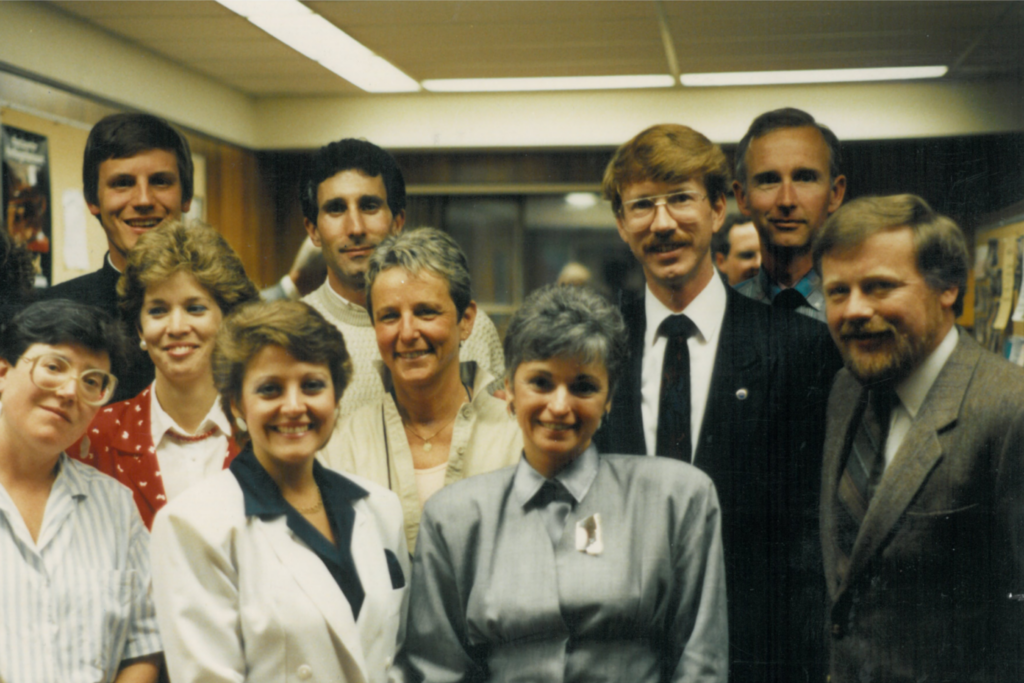
Q&A

When did you start teaching/coaching at the Centre for Conflict Resolution?

Started coaching in rural areas of BC with various instructors in 1993 and then in 1998 and taught at the University of Calgary JI Programram

What inspired you to become a Conflict Resolution faculty member?

Took an Instructor Training Program with Marj Burdine

8.How did you hear Centre for Conflict Resolution at the JIBC?Single line text.

Through my friend Phyllis Nordquist who called himself a reformed Lawyer (who was taking courses at the JI) in 1991

What was your job(s) before teaching at the JIBC?

Business Owner in training and sales

What is the most important thing you hope your students leave your classroom with?

All conflict has possibility and can be resolved – we just have to find a way!

  • Sharon Wilson

Learning in place at Jericho Beach (faculty stories)

It is especially delightful to look back on those years of training, friendship, adventure, and staying on-site at the Original JI (alongside Jericho Beach) with my friend Phyllis Nordquist in her motorhome. Our days at the JI were filled with courses, learning and work to develop skills. We often role-played in the evenings at the Menno Simmons Centre with the help of coaches Gary Harper, Dale Zaizer and others. We spent our days focused on learning and applying the concepts and skills to manage difficult situations, navigate human behaviour and how to effectively facilitate conflict resolution. Little did we know that some of the most memorable lessons in human behaviour would include walks along Jericho Beach after class, as we set out to enjoy some fresh air and peaceful surroundings, and to our surprise more than once encountered a few sights that were impossible to unsee. Some of the unexpected displays of human anatomy and behaviours with much laughter and improvisation soon became part of role-plays as a means to maintain composure while navigating extreme human behaviour and beliefs about modesty and rights to sunbathing. Looking back, the JI experience of the courses, the pleasure of learning from the amazing Instructors and Coaches (many pictured in the invitation), along with the simple pleasure of sharing learning with a friend and so many terrific fellow students, the stories, the laughter. Who knew that a couple of year of learning about conflict could involve so many adventures, the morning rituals, meeting for coffee at Murchie’s, followed by decadent desserts and many culinary indulgences together.

  • Sharon Wilson

Opening a door (Faculty stories)

Oh, the memories of 1991-1992, what started as a communications course to enhance my work grew into a deeply rewarding professional journey that has been both personally and professionally life-changing. Looking back, my training and experiences at JI became the foundation for what would grow into a deeply rewarding 34-year career as a full-time mediator, facilitator and instructor in conflict resolution. Over the years, I have had the privilege of working with countless individuals, teams and organizations, supporting people through difficult conversations, challenging relationships and opportunities for positive change. I have also had the opportunity to teach hundreds of students the skills and processes of mediation and conflict resolution. I don’t share this as an accomplishment so much as an expression of gratitude. The knowledge, wisdom, encouragement and example of the many mentors, instructors and coaches who crossed my path helped shape not only my professional practice but also the person I am today. The whole JI experience and wonderful people, opened a door, introduced me to people who would influence my life in lasting ways, and set me on a path I could never have fully anticipated. For that, I remain profoundly grateful to JI and to everyone who shared their knowledge, experience, and guidance along the way. The opportunity to pass some of those teachings forward and, hopefully, make a positive difference in the lives of others has been one of the greatest gifts of my career.

  • Sharon Wilson

Living one’s calling (Faculty Stories)

It’s been a blessing being a faculty member of the Centre for Conflict Resolution. Fairness and justice are two of my most deeply held values and each time I stepped into the classroom, I had the opportunity to live my calling. In teaching collaboration skills, I was able to talk about, explore and live what has been most important to me. In fact, doing this work has felt more like a spiritual or soul practice than a career. Living my calling and sharing the stirrings of my heart.


  • Deborah White

Teaching moments outside the classroom window (faculty stories)

One of the funniest and most syncronous moments was when I was teaching back at the former Jericho site. There was a Police Academy simulation going on where recruits were having to accost and arrest very angry would-be criminals. The actors playing the would-be’s were wearing red rubber suits that made them look like the Michelin Man on a bad day.

I was teaching Dealing with Anger and we were right in the midst of talking about what happens to the body and brain during activation when one of the would-be criminals was plastered up against the window with a police recruit grabbing him from behind. “Keep your f–cking hands off me!!” There were gasps, flinches and looks of shock.

Teaching moment! “OK – let’s talk about adrenaline and what’s happening for you right now.”

When did you start teaching/coaching at the Centre for Conflict Resolution?

in the 19080s

What inspired you to become a Conflict Resolution faculty member?

I was teaching mediation and conciliation skills to Probation Officer/Family Court Counsellor recruits and Marj Burdine was just starting up her mediation classes. I got to attend the first one. After that, I knew I wanted to stay involved and connected with the program from that point on.

How did you hear Centre for Conflict Resolution at the JIBC?

I was working there and got to see it start from the very beginning.

What was your job(s) before teaching at the JIBC?

I was an instructor at the Corrections Academy teaching Probation Officers and Family Court Counsellors.

What is the most important thing you hope your students leave your classroom with?

Hope that managing conflict well will have a positive impact on their relationships in all areas of their lives. It will help pass on desire for collaboration, fairness and justice.

  • Deborah White

From the living room to the classroom (faculty stories)

I remember sitting in my living room on West 21st and Quesnel with about 8 or 9 really nice adults who worked together at a place called “The Centre”, or “The JI” – the two names were interchangeable.

I was about 17 (in 1986), and “mom” (Marje Burdine) was feeding and wine-ing participants at this evening’s “working session”. Something called “The Assessment” was taking up a particularly large portion of the room’s oxygen. And in the middle of the excited exchange, the family dachshund (Willy) strode into the middle of the room and proceeded to soil the carpet. I don’t think it was a commentary on the quality of conversation, or the assessment for that matter. Willy’s toothpaste-tube impersonation brought a mixture of gasps (more of a scream from mom) followed by a round of hearty belly laughter from the con res folx.

That is one of the earliest memories I have about the Centre and the fine humans who brought it to life as faculty and staff. Little did I know that I would eventually be learning directly from them as my instructors, and even be working with many of them as fellow faculty.

My educational and professional path took me to UBC, and then to Geneva Switzerland and back. I took courses at the old JI site on Jericho hill as a teenager (loved the muffins!), and eventually at the New West campus as a young adult in the late 90’s upon my return from Europe. By then, mom had left the JI for a successful career as a sole practitioner.

I always felt that the JI classroom was a deeply connecting, and at the same time, a slightly daunting, place. I was the child of a pioneer, and literally grew up with some of the biggest and best names in the field. I felt like I belonged, and yet wanted so badly to “be good at this stuff”. That was a lot of pressure to put on myself.

Well, after 23 years as a member of the Con Res faculty and management team, I can look back at that young man’s face and say…”you’ll get there” (most times, anyway).

I have had the extreme privilege and pleasure to have learned from and worked with the “early years” best: Mom and her husband-Ed Jackson, Michael Fogel (my mentor), Tad Dick, Stacey Holloway, Arthur Ridgeway, Joan Balmer, Gordon Sloan, Nancy McPhee, Terry Nyman, Peggy English, Mario Govorchin, Donna Soules, Ron Monk, Nym Hughes, Dale Zaiser, Gordon White, Sally Campbell, Deborah White and many, many more.

So, when people ask me about how I came to be Dean at the JI, I say it took two ingredients: nepotism and attrition!

  • Kent Highnam

A transition from bureaucrat to conflict resolution professional (student stories, faculty stories)

In late 1987 I attended a presentation on mediation in which it was described as “helping others to resolve their issue” (as opposed to the traditional litigation model). I knew in that moment I had found my calling. Shortly after, I attended Conres 101 at what was then the Jericho location of the J. I. This placed me in the second wave of graduates and although we didn’t have cohorts per se, the program was small enough that by its end, students had bonded and gotten to know faculty well. Some random memories included moving the class one summer day from the stuffy classroom to beneath a magnificent nearby oak tree.

Some of the trainers and coaches who influenced me were Michael Fogel, Karen Haddigan and then coaches Jill Schroeder and Mike Reynolds (among others). Michael would appear on day one of a training resplendent in sports coat and tie. By day two he’d lose the tie and by day 5 he’d have his sleeves rolled up. Stacey Holloway and Mario Govorchin were also very supportive as I transitioned from bureaucrat to conflict resolution professional. All the while I was diligently practicing my communication skills, especially open-ended questions. As a “recovering lawyer” this was a challenge but gradually became natural.

By the time I graduated I not only had my certificate, but a community of like-minded and very interesting and eclectic people. From a student’s perspective, the courses were well structured and effective, though given the newness of the program I wonder if the metaphor of a duck might have been apt – calm on the surface but feet paddling frantically underwater. It was an exciting time.

The training and support I received allowed me to transition from student to practitioner, part of which was coaching. I particularly enjoyed road trips on which I got to know my colleagues on a personal level. Flying into Fort St. John in the winter was definitely a bonding experience. Another travel memory was getting seasick on the ferry ride to Lasqueti Island, only to be welcomed by a multitude of “earth mothers” who nursed me back to health. The annual retreats and other professional development workshops were also highlights – especially when staying overnight on Bown Island or up the Fraser Valley.

Because of my varied background as both a bureaucrat and a small business owner (my mother said it was because I couldn’t hold a job), I was able to effectively customize trainings for the J.I. with such diverse groups as bylaw officers, bankers and forestry workers. I knew a training was hitting the mark when a student would look at a scenario and comment “were you in our staff meeting last week?” As a trainer I remember the immense satisfaction and joy that came when a group came together and created learning magic.

Finally, as an author, the seed from which “The Joy of Conflict Resolution” grew was planted by Ken Cloke as a brief aside in a professional development workshop when he quickly sketched the “drama triangle of conflict”. In the spirit of collaboration the final chapter (“Tips for the Traveller”) was comprised of dozens for experiences and suggestions tips from my colleagues at the J.I. Overall, I was fortunate to be in the right place at the right time to discover and pursue a career that was “right livelihood”. Having been retired for ten years I look back on my 25 years with the program and feel proud to have played a part in the evolution of the Centre for Conflict Resolution.

  • Gary Harper