Engaging with conflict with empathy and curiosity

Category: Student Alumni

A transition from bureaucrat to conflict resolution professional (student stories, faculty stories)

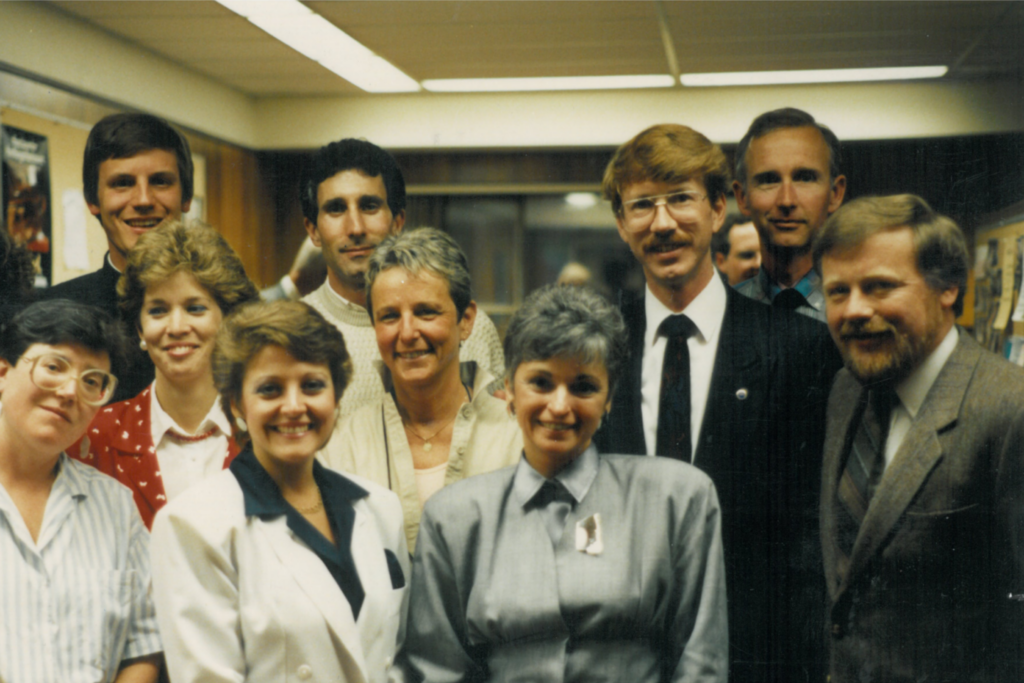
In late 1987 I attended a presentation on mediation in which it was described as “helping others to resolve their issue” (as opposed to the traditional litigation model). I knew in that moment I had found my calling. Shortly after, I attended Conres 101 at what was then the Jericho location of the J. I. This placed me in the second wave of graduates and although we didn’t have cohorts per se, the program was small enough that by its end, students had bonded and gotten to know faculty well. Some random memories included moving the class one summer day from the stuffy classroom to beneath a magnificent nearby oak tree.

Some of the trainers and coaches who influenced me were Michael Fogel, Karen Haddigan and then coaches Jill Schroeder and Mike Reynolds (among others). Michael would appear on day one of a training resplendent in sports coat and tie. By day two he’d lose the tie and by day 5 he’d have his sleeves rolled up. Stacey Holloway and Mario Govorchin were also very supportive as I transitioned from bureaucrat to conflict resolution professional. All the while I was diligently practicing my communication skills, especially open-ended questions. As a “recovering lawyer” this was a challenge but gradually became natural.

By the time I graduated I not only had my certificate, but a community of like-minded and very interesting and eclectic people. From a student’s perspective, the courses were well structured and effective, though given the newness of the program I wonder if the metaphor of a duck might have been apt – calm on the surface but feet paddling frantically underwater. It was an exciting time.

The training and support I received allowed me to transition from student to practitioner, part of which was coaching. I particularly enjoyed road trips on which I got to know my colleagues on a personal level. Flying into Fort St. John in the winter was definitely a bonding experience. Another travel memory was getting seasick on the ferry ride to Lasqueti Island, only to be welcomed by a multitude of “earth mothers” who nursed me back to health. The annual retreats and other professional development workshops were also highlights – especially when staying overnight on Bown Island or up the Fraser Valley.

Because of my varied background as both a bureaucrat and a small business owner (my mother said it was because I couldn’t hold a job), I was able to effectively customize trainings for the J.I. with such diverse groups as bylaw officers, bankers and forestry workers. I knew a training was hitting the mark when a student would look at a scenario and comment “were you in our staff meeting last week?” As a trainer I remember the immense satisfaction and joy that came when a group came together and created learning magic.

Finally, as an author, the seed from which “The Joy of Conflict Resolution” grew was planted by Ken Cloke as a brief aside in a professional development workshop when he quickly sketched the “drama triangle of conflict”. In the spirit of collaboration the final chapter (“Tips for the Traveller”) was comprised of dozens for experiences and suggestions tips from my colleagues at the J.I. Overall, I was fortunate to be in the right place at the right time to discover and pursue a career that was “right livelihood”. Having been retired for ten years I look back on my 25 years with the program and feel proud to have played a part in the evolution of the Centre for Conflict Resolution.

  • Gary Harper

Making things as right as possible (student stories)

One of my favorite takeaways from my Mediation and Negotiation training is the question:

“What would it take to make things as right as possible?”

I have carried that question with me for years.

Sometimes there is simply no way to turn back the clock. Something has happened. People are angry or hurt, and they do not know how to move forward. Often they want to keep explaining what went wrong or venting about what should have happened.

But asking, “What would it take to make things as right as possible?” gently turns the conversation toward the future.

I have found that simply thinking through that question can lower the emotional anxiety in the room. It can help people get unstuck. Sometimes it even opens the door to a conversation that did not seem possible a few minutes earlier.

That one question has served me remarkably well.

– Ritchard

I Had Run Out of Language (student stories)

In 2011, I met a fellow at a gathering who worked in mediation at the Abbotsford Correctional Institute. I was intrigued by what he did, so we met for coffee. During that conversation, he told me about the Justice Institute of British Columbia and its conflict resolution training.

I had no idea such training existed.

At the time, I had been working with a nonprofit in northern Brazil for about eighteen years. I was the founder and leader of an international team that included about six expatriate families. We were all trying hard to work well together, but I had reached a ceiling. We were encountering relational impasses, and I had run out of language, experience, and ideas for how to move forward.

A Canadian businessman offered to pay for my studies, and since I had six months in Canada, I enrolled at JIBC in mediation and negotiation training.

I loved it.

What especially worked for me was the rhythm of theory, practice in small groups, reflection on what had happened, and then more practice. The situations we worked through felt remarkably close to the world in which I was already living and leading.

One of my biggest surprises was discovering how bad I was at some of it.

I thought I understood negotiation. But underneath that confidence was an assumption I had barely noticed: a successful negotiation meant that, somehow, I got my way in the end. In class we were learning something quite different—that a strong outcome allows both sides to walk away genuinely satisfied.

Then came the role-plays, the cameras, the feedback, and the uncomfortable experience of watching myself.

Again and again, I could see tendencies toward “power over”—trying to control the outcome, persuade too strongly, or subtly get my way. That was not easy to see. I had been leading people for years. I thought I was farther down the road than I was.

That realization became one of the most valuable parts of my education.

I completed the remaining requirements and final evaluations online and finally received my certificates in 2021. Once again, the evaluation process surprised me. I discovered that I still needed to move farther toward calm patience, genuine curiosity, and the ability to see the larger picture rather than pushing too quickly toward resolution.

Since then, I have completed a PhD in Organizational Leadership and have continued working in Brazil and internationally with teams and leaders, sometimes in high-stress and cross-cultural situations.

Through all of that, the foundations I received during those intensive months at JIBC have stayed with me.

The courses gave me more than techniques for negotiating or mediating. They helped change the way I understand conflict—and the way I understand myself when I am in the middle of it.

More than fifteen years later, I am still learning those lessons.

I am deeply grateful to the Justice Institute of British Columbia for that investment in my life, and for helping me learn how to work more thoughtfully, patiently, and constructively with people when things become difficult.

~ Ritchard

Tools to live by (student stories)

I was a student in a Buddhist tradition, and I believed that meditation was the answer to everything. But I had always been curious about communication and decided to take your introductory course. That first course, led by Kelly Henderson, blew my world apart. Her kindness and skillfulness enabled me to see things that were way outside my comfort zone. Before the course, I thought I pretty much had everything together. Afterwards, I felt completely humbled and knew I had a lot to learn.

I continued with the training, spacing the courses at long intervals so that I had time to digest the material and practice the skills. About a year later I was walking down the corridor on my way to a class when the thought came to me, “This is how I can live according to my vows.” Buddhadharma had given me the view; JIBC gave me the tools to turn that view into reality.

I am eternally grateful to JIBC for the wisdom, kindness, and patience of the instructors. You changed my life.

-Trime

Transformational Learning (student stories)

One of my most memorable life moments happened in a JIBC conflict-resolution course. I raised my hand to ask a question. I don’t remember the question, but I clearly remember the answer. The instructor looked at me and said, “Your feelings are valid, and they’re nobody’s fault.” That statement reverberated through my whole being, and has reverberated through my life ever since.

I grew up in an angry home environment and had lots of anger issues of my own. The only anger language I knew was the language of blame. JIBC taught me to take responsibility for myself and to take a genuine interest in others. The lessons transformed my life.

-Trime

Empathy as power (student stories)

Usual day in class where I was sitting there with my peers as we discussed conflict in the workplace. But as the teacher was explaining an idea, he quickly said ’empathy is the most powerful word in the english language’. immediately, i thought that was a very large thing to claim. Yet here I am, over 10 years after the class and I cannot agree more strongly. So many instances of conflict can be boiled down to communication and communication is best done with empathy. These courses I took so long ago changed my life. That sounds like a very large thing to claim, but its true.

Submitted by: Brandon